

Athens taxi rates in 2026
The transport ministry publishes a tariff schedule that every licensed cab has to follow, the taximeter is sealed, and the driver cannot legally charge above whatever shows on that dial at the end of the trip. For 2026 the schedule lands at EUR 1.80 to start the meter, EUR 0.90 a kilometre during the day and EUR 1.25 a kilometre at night inside the city, with a floor of EUR 4.00 below which no fare can settle. Then there is the airport. That route plays by its own rule, a regulated flat fare of EUR 40 in daylight and EUR 55 overnight, regardless of what the meter would otherwise have produced.
Base fee
The flag drop is EUR 1.80. A short hop still pays the EUR 4.00 minimum.
Per-kilometre rate
EUR 0.90 between 05:00 and midnight, EUR 1.25 between midnight and 05:00, inside Athens.
Airport flat rate
EUR 40 in daylight, EUR 55 overnight, between Athens International Airport and central Athens. Up to four passengers, headline price.
Athens taxi rates at a glance
Three numbers cover most rides a visitor will take.
EUR 1.80 lights the meter when the door closes. EUR 4.00 is the smallest amount any receipt can show. Inside Athens the kilometres bill at EUR 0.90 in daylight, EUR 1.25 after midnight. The airport route ignores the meter math entirely and sits on a flat EUR 40 daytime, EUR 55 nighttime, identical for one person or four.
If a taxi is dropping you at the Acropolis or another archaeological site, book entry tickets in Athens in advance to skip the line.
How is the taxi meter calculated in Athens?
A sealed device does the maths. The Greek transport ministry certifies the taximeter on every licensed cab, slaps a seal on the unit, and makes it a regulatory offence to tamper with the seal or the device underneath. As the cab moves, the meter quietly stacks four numbers into a running total: the flag drop, the kilometres, the waiting clock, and any regulated surcharge that applies on the route or at the hour in question.
The flag drop is EUR 1.80. It posts to the dial the moment the meter engages. Kilometres accumulate after that, at whichever tariff is active, and the dial communicates that choice with a single digit. 1 means daytime, the band labelled Tariff 1, in force from 05:00 to midnight inside city limits. 2 means nighttime, Tariff 2, from midnight to 05:00. The moment a metered ride leaves the urban perimeter for the airport corridor or for a suburb beyond the ring road, the dial flips to a single zone rate that mirrors Tariff 2 at any hour of the day. Suburban and intercity trips simply are not urban work, and the tariff sheet treats them that way.
Waiting time is its own line item. Sitting in traffic counts. Pausing on a passenger's request counts too. The dial ticks at EUR 15 per hour while the cab is stationary, billed in fractions, which works out to roughly EUR 0.25 a minute. At the end of the trip the screen pulls everything together: flag drop, distance, waiting, surcharges, and the EUR 4.00 minimum-fare guarantee.
What is the difference between Tariff 1 and Tariff 2?
Two tariffs on the same clock face. Tariff 1 runs 05:00 to 23:59. Tariff 2 runs 00:00 to 05:00, plus Easter night, plus a handful of other regulated dates that the schedule names explicitly. The flag drop does not move. Only the per-kilometre rate does.
| Element | Tariff 1 (day) | Tariff 2 (night) |
|---|---|---|
| Time window | 05:00 to 23:59 | 00:00 to 05:00 |
| Base fee (flag drop) | EUR 1.80 | EUR 1.80 |
| Per-kilometre inside city limits | EUR 0.90 | EUR 1.25 |
| Per-kilometre outside city limits | EUR 1.25 | EUR 1.25 |
| Minimum fare | EUR 4.00 | EUR 4.00 |
| Waiting time per hour | EUR 15 | EUR 15 |
That in-city per-kilometre line is where the gap lives. Tariff 2 sits at roughly 39 percent above Tariff 1. So a ride that would have come in at EUR 8 around lunchtime can land closer to EUR 11 at three in the morning, even though the kilometres are the same, the route is the same, and the driver is the same person.
What is the airport flat rate from Athens International Airport?
The airport plays by its own book. On the corridor between Athens International Airport (Eleftherios Venizelos) and central Athens, the meter is not the operative figure. A regulated flat fare takes its place: EUR 40 from 05:00 to midnight, EUR 55 from midnight to 05:00. One passenger or four, the receipt total is the same. Bigger vehicles run on their own published flat tariffs. Minivans seat up to eight passengers. Minibuses go up to fourteen.
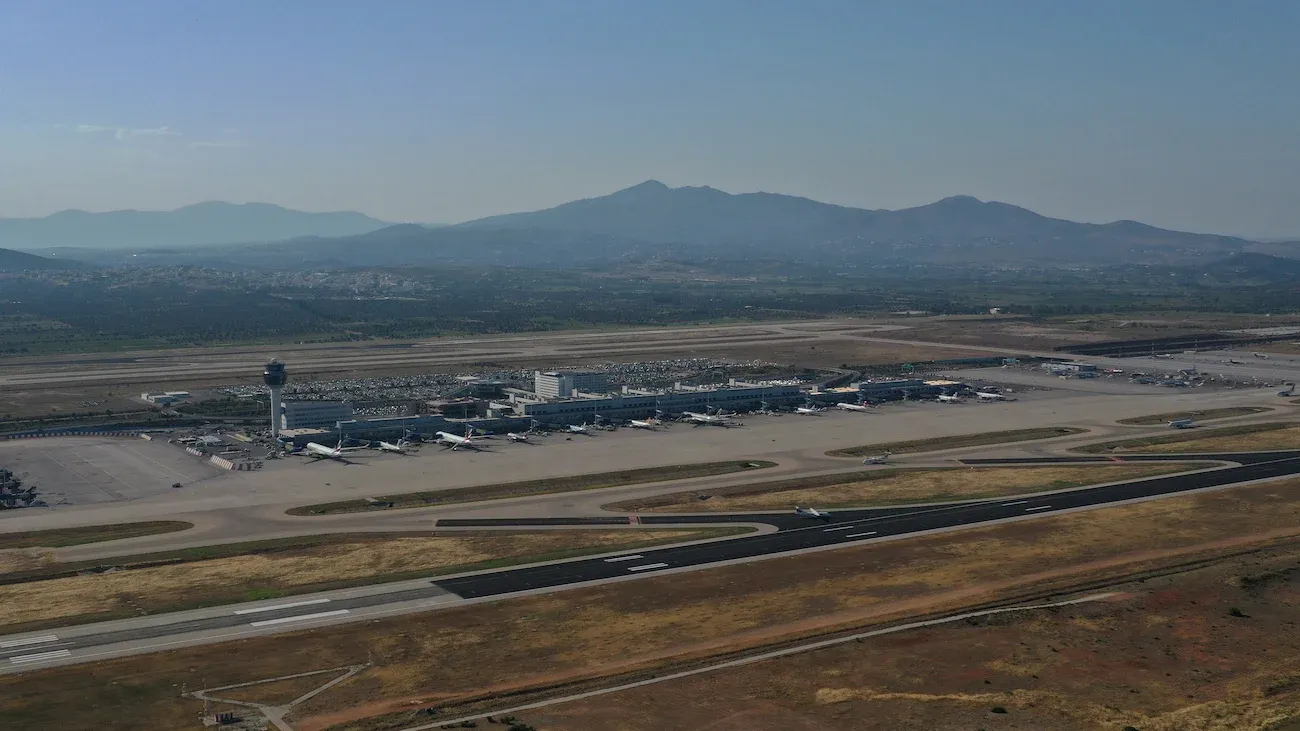
That EUR 40 is supposed to be the whole bill. It absorbs every Attiki Odos motorway toll, the airport pickup supplement, and standard luggage. So when the receipt arrives, it should match the headline figure rather than show a parade of small add-ons stacked on top. A driver who suggests "running the meter instead" on the airport route is not following the regulated default. The remedy is simple, the passenger asks for the Flat Rate by name.
Pre-booked private operators usually quote around EUR 45 daytime for the same airport trip. The premium buys a Mercedes-Benz sedan, a meet-and-greet at the arrivals hall, and live flight tracking that means the driver shows up even if the plane lands an hour late. Pickups between 23:00 and 05:00 normally add around EUR 10 to the daytime quote, which mirrors the regulated night premium fairly closely. Anything that lands materially above those figures, on a standard sedan, signals a problem.
Piraeus port and other common transfers
Apart from the airport, only a few corridors carry most of the visitor taxi traffic. Piraeus, the coastal Athenian Riviera, and the secondary ports of Rafina and Lavrio do most of the work. The table below collects the 2026 ballpark fares for a standard four-passenger cab.
| Route | Daytime fare | Nighttime fare |
|---|---|---|
| Athens city centre to Piraeus port | EUR 25 | EUR 35 |
| Athens International Airport to Piraeus port | EUR 60 | EUR 70 |
| Athens International Airport to Rafina port | EUR 45 | EUR 55 |
| Athens International Airport to Lavrio port | EUR 60 | EUR 70 |
| Athens International Airport to Glyfada, Voula or Vouliagmeni | EUR 45 | EUR 55 |
| Athens International Airport to Sounion | EUR 60 | EUR 70 |
| Piraeus port to the Plaka district | EUR 25 | EUR 35 |
Of those, only the city-centre-to-Piraeus run is really a metered Tariff 1 ride that happens to line up with a typical operator quote. The rest sit on regulated flat fares published by the Athens taxi syndicate, with the same passenger-count rule as the airport line. Up to four people, headline price.
Which surcharges and add-ons legitimately appear on the meter?
A small set of regulated surcharges can legitimately push a final fare above the basic per-kilometre math. All of them have to be itemised, line by line, on the printed or electronic receipt that the driver hands over at the end of the trip.
The 2026 list:
- Pre-booking or radio call. EUR 5.65, charged when the cab is dispatched by phone, an app, or a hotel concierge rather than flagged in the street.
- Luggage over 10 kilograms. EUR 0.39 per piece in the boot.
- Airport pickup supplement. EUR 4.00 when the meter runs on a trip starting at Athens International Airport instead of the regulated flat fare.
- Port, railway or bus station pickup. EUR 1.30 at Piraeus, Rafina and Lavrio ports, Larissa railway station, and the KTEL intercity bus terminals.
- Christmas, New Year and Easter bonus. A regulated holiday surcharge, usually EUR 1.00 flat, on the published holiday days.
- Tolls. Passed through at cost. The Attiki Odos toll plates show up on most airport-corridor receipts.
Items outside that list sit outside the fare schedule. Made-up "premium" supplements, surprise night fees that fire outside the Tariff 2 window, vague "airport tax" charges. None of those are authorised.
How does Uber work in Athens?
Uber operates in Athens, but not the Uber that visitors might know from London or San Francisco. Greek private-hire law shuts down unlicensed ride-share, so UberX and Uber Black are simply not options in Greece. The only product on the menu is Uber Taxi, an app-side booking layer that dispatches the same licensed yellow cab any visitor could have hailed in the street. The driver is the same person. The vehicle is the same cab. The fare runs on the regulated meter or, on the airport route, the regulated flat fare.
The local rival is FreeNow, the rebrand of Beat. FreeNow has been the dominant Greek ride-hailing app for most of the last decade, and it works the same way as Uber Taxi behind the scenes. It dispatches licensed Athens taxis on the regulated fares. App dispatch adds a small booking fee on top of the meter total, in line with the EUR 5.65 radio-call surcharge.
So the price gap between hailing on the street and booking through an app is small. The real difference is predictability:
- Street hail. The cheapest in absolute terms, because there is no booking fee. The cab has to be flagged down, and the tariff digit on the meter needs a manual check.
- Uber Taxi or FreeNow. The same metered fare plus the booking fee. The app shows a fare estimate up front, locks the trip to a GPS-tracked route, accepts card payment, and emails the receipt automatically.
- Pre-booked private transfer. A higher fixed fee, which buys a premium sedan, a meet-and-greet, and flight tracking. Useful mainly on the airport corridor, where the typical EUR 45 daytime quote sits above the regulated EUR 40.
Payment, tipping and receipts
When it comes to paying for your ride, both cash and cards work in every licensed Athens taxi. Under Greek law, cabs are strictly required to carry a working POS card terminal, meaning a blanket refusal to accept a card is an actual regulatory breach. However, real-world practice can be a bit messier. Some drivers simply prefer cash and will claim their terminal "does not work" to deflect the request. Experienced travelers quickly learn to spot this classic excuse, so keeping small euro notes and coins handy for short rides easily removes any potential awkwardness. If you want to sidestep the payment conversation entirely, simply use app-based services like Uber Taxi or FreeNow, which handle the transaction automatically through your registered card.
Tipping in Athens is completely optional and stays wonderfully modest. The local default is just rounding up your metered fare to the nearest euro. On longer journeys, such as an airport transfer, leaving 5 to 10 percent is considered quite generous. Drivers do not expect a fixed gratuity, and you face absolutely zero social penalty for paying exactly what the dashboard dial shows.
Receipts, on the other hand, are not optional for the driver. Every licensed cab must issue a printed or electronic slip the moment you request it. This vital slip carries the license plate, the date and time of the trip, the metered fare with every single surcharge itemized, and the driver's tax identification number. Asking for that receipt at the end of your ride is the single best dispute-prevention step you can take as a passenger. That simple piece of paper serves as undeniable proof of whether the correct tariff and legitimate surcharges were applied to your journey.
How can visitors spot and avoid Athens taxi scams?
Most Athens cab drivers run the meter honestly. A minority test foreign visitors with the standard overcharging playbook, and the meter plus the receipt make that playbook easy to defeat. The patterns that visitor forums and consumer reports flag most often:
- Check the digit on the meter at the start of the ride. A daytime trip shows 1. A nighttime trip after midnight shows 2. A driver who flips to Tariff 2 outside the regulated window is overcharging.
- Insist on the meter running. The dial has to engage before the cab moves, except on routes with a published flat fare such as the airport corridor. A verbal quote without the meter on a regular city ride is a red flag.
- Reject vague "fixed price" quotes. Only the airport corridor, the airport-to-port corridor, and a handful of other published routes carry regulated flat fares. A street hail in Plaka quoting a "special price" to Syntagma Square is overcharging.
- Refuse uninvited shared rides. Picking up extra passengers without the original passenger's consent is illegal under Greek transport law. A licensed taxi belongs to its hirer for the full duration of the trip.
- Cross-check the route on a phone map. Reasonable detours happen because of traffic. Looping the long way around for no reason does not.
- Ask for the printed receipt. The slip carries the licence plate and the metered breakdown. That paper is the evidence base for any complaint to the Athens municipal authority.
- Use FreeNow or Uber Taxi for high-risk legs. Late-night airport pickups, port arrivals after a long flight, rides with heavy luggage. Those are the moments where the GPS tracking and the fare preview of an app remove the negotiation entirely.
What do sample fares look like on popular Athens trips?
Below are representative metered fares for the trips visitors actually take. Real-world totals shift with traffic and route choice, but the bands cover the typical range. All amounts in euros, standard four-passenger cab.
| Route | Syntagma Square to the Acropolis |
|---|---|
| Approximate distance | 2 km |
| Tariff 1 fare | EUR 4.50 to 6 |
| Tariff 2 fare | EUR 5 to 7 |
| Route | Plaka to Piraeus port |
|---|---|
| Approximate distance | 11 km |
| Tariff 1 fare | EUR 15 to 18 |
| Tariff 2 fare | EUR 20 to 25 |
| Route | Syntagma Square to Athens International Airport |
|---|---|
| Approximate distance | regulated flat |
| Tariff 1 fare | EUR 40 |
| Tariff 2 fare | EUR 55 |
| Route | Acropolis to Athens International Airport |
|---|---|
| Approximate distance | regulated flat |
| Tariff 1 fare | EUR 40 |
| Tariff 2 fare | EUR 55 |
| Route | Monastiraki to Glyfada |
|---|---|
| Approximate distance | 18 km |
| Tariff 1 fare | EUR 22 to 26 |
| Tariff 2 fare | EUR 28 to 32 |
| Route | Kolonaki to Piraeus port |
|---|---|
| Approximate distance | 12 km |
| Tariff 1 fare | EUR 16 to 20 |
| Tariff 2 fare | EUR 22 to 27 |
| Route | Omonia to the National Archaeological Museum |
|---|---|
| Approximate distance | 1 km |
| Tariff 1 fare | EUR 4.00 (minimum) |
| Tariff 2 fare | EUR 4.00 (minimum) |
| Route | Plaka to Athens International Airport |
|---|---|
| Approximate distance | regulated flat |
| Tariff 1 fare | EUR 40 |
| Tariff 2 fare | EUR 55 |
| Route | Piraeus port to Athens International Airport |
|---|---|
| Approximate distance | regulated flat |
| Tariff 1 fare | EUR 60 |
| Tariff 2 fare | EUR 70 |
| Route | Glyfada to the Acropolis |
|---|---|
| Approximate distance | 14 km |
| Tariff 1 fare | EUR 18 to 22 |
| Tariff 2 fare | EUR 25 to 30 |
The EUR 4.00 minimum-fare rule turns up everywhere. Very short rides inside the city always settle at that figure, even when the per-kilometre maths would have come in lower.