
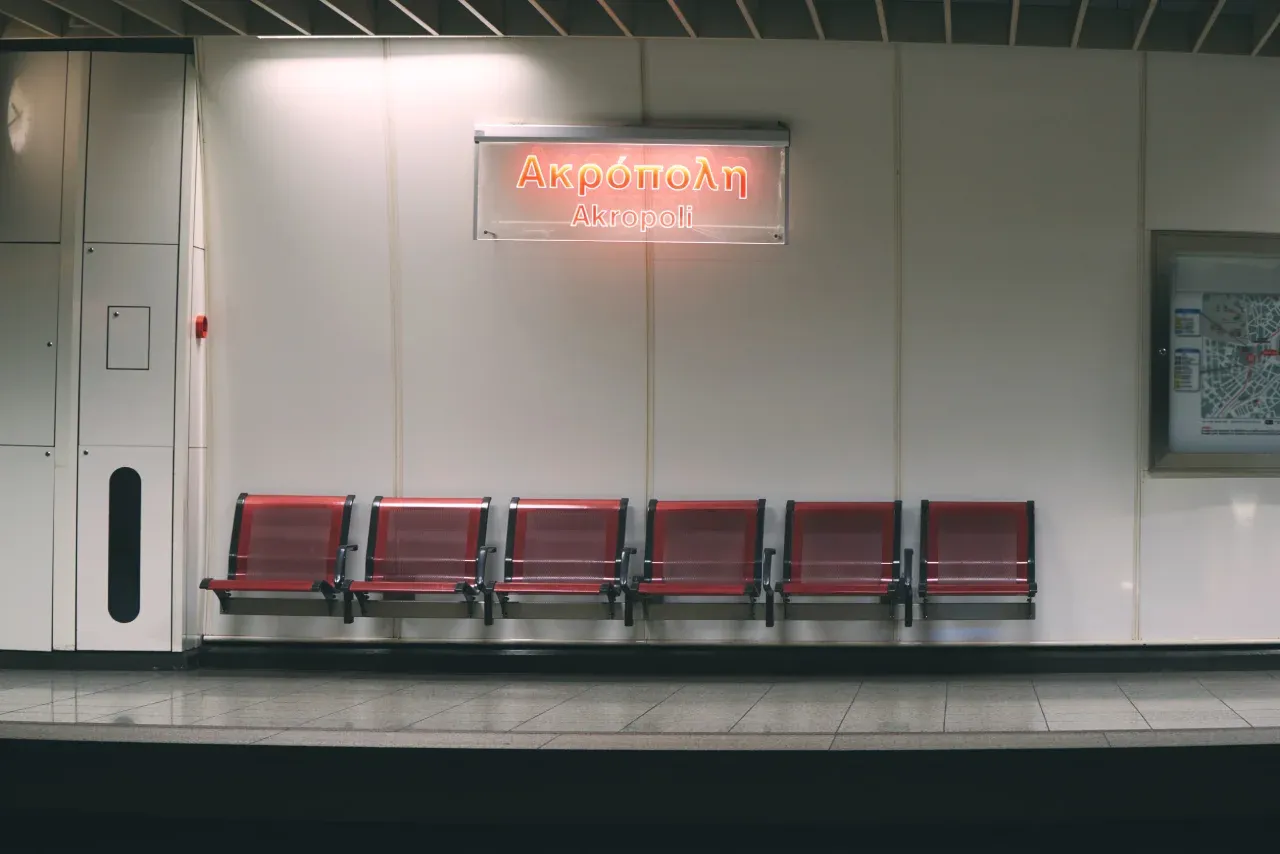
How to use the metro in Athens?
Three options buy a ride on the Athens Metro: a paper Ath.ena Ticket, a reloadable Ath.ena Card and a contactless Visa or Mastercard tapped at the validator. The standard 90-minute single fare comes to €1.20 on any of them, and the same ticket covers transfers to trams, buses, and trolleybuses inside that window.
Three lines do most of the work for tourists. Line 1 (Green) crosses the city and ends at Piraeus port. Line 2 (Red) hits the Acropolis. Line 3 (Light Blue) connects Eleftherios Venizelos International Airport (ATH), Syntagma station, Monastiraki station, and Piraeus.
Two taps, both at the gate. One on the way in, one on the way out. If you get the second one wrong, and an inspector with a handheld scanner can turn that oversight into a €72 fine.
What are the three Athens Metro lines?
Three lines today. A fourth in construction, due late this decade.
Line 1 (Green)
Built first, by a long way. Steam railway in 1869, electrified in 1904. Twenty-four stations along roughly 25.6 kilometres get from Piraeus port up to Kifissia in the northern suburbs. Most of the line runs above ground, so travellers see the city instead of tunnel walls. Trains arrive every 5 to 10 minutes during the day. End to end takes 50 to 60 minutes if a passenger is unlucky enough to ride it that far.
Line 2 (Red)
All underground. Anthoupoli to Elliniko, twenty stations along about 18 kilometres. End to end is about 35 minutes. At rush hour trains come every 3 to 6 minutes; off-peak more like 10. Line 2 is the one that drops travellers at Akropoli station for the Acropolis, and at Syntagma for the centre.
Line 3 (Light Blue)
The big one. 47.3 kilometres, 27 stations, the longest line in the network. It begins at Dimotiko Theatro in Piraeus, runs through Monastiraki station and Syntagma station in the centre, and finishes at Eleftherios Venizelos International Airport (ATH) out east. The Piraeus end is recent: three new stations (Maniatika, Piraeus, and Dimotiko Theatro) opened on 10 October 2022. Whole-line Piraeus to airport runs about 65 minutes.
Frequencies on Line 3 are split. Inside the city, between Dimotiko Theatro and Doukissis Plakentias, trains roll every 4 to 9 minutes. The airport branch is a different animal. It runs every 36 minutes throughout the day. The reason is mechanical, not editorial: only seven dual-voltage trains can operate the shared Suburban Rail tracks east of Doukissis Plakentias, and that fleet limits the schedule.
Line 4 (Orange)
Line 4 is being built. Its route will pass through residential and tourist neighbourhoods including Kolonaki and Exarcheia. Opening is somewhere in the late 2020s rather than mid-decade.
Which station serves which Athens attraction?
A handful of metro stations cover most of the tourist map. The table below pairs each major Athens attraction with the closest station and its line.
| Attraction | Metro station | Line |
|---|---|---|
| The Acropolis | Akropoli | Line 2 |
| Plaka, Monastiraki square and market, Ancient Agora | Monastiraki | Lines 1 and 3 |
| Syntagma Square, Hellenic Parliament, Ermou shopping street | Syntagma | Lines 2 and 3 |
| Acropolis view, Ancient Agora (alternative side) | Thissio | Line 1 |
| Piraeus port and ferries to the islands | Piraeus | Lines 1 and 3 |
| National Archaeological Museum | Victoria | Line 1 |
| Athens Concert Hall (Megaron) | Megaro Moussikis | Line 3 |
| Vasilissis Sofias Avenue and Evangelismos Hospital | Evangelismos | Line 3 |
| Gazi nightlife district | Kerameikos | Line 3 |
Six of those stations double as small archaeological sites in their own right. Workers digging the tunnels turned up artefacts at Akropoli, Monastiraki, Syntagma, Dafni, Evangelismos, and Panepistimio, and rather than ship the finds to a museum somewhere else, the metro left them where they came up. Monastiraki has a section of the Eridanos riverbed visible behind glass. Syntagma displays grave goods and pottery from the surrounding Athenian quarter. The displays sit inside the paid area of each station, so anyone with a valid ticket walks past them for free.
What are the Athens Metro operating hours?
The athens metro opening hours are roughly 05:30 to 00:30 from Sunday through Thursday. Lines 2 and 3 extend service to about 02:00 on Friday and Saturday nights. The metro does not run 24 hours on any day of the week. Overnight transport between roughly 02:00 and 05:30 falls to OASA night buses and the X95 and X96 airport-express services.
| Service / Line | Line 1 (Metro) |
|---|---|
| Days | Every day |
| Operating Hours | 05:30 – 00:30 |
| Details & Frequency | Last regular trains leave terminal stations between 00:05 and 00:15. Frequency: 5 to 10 min. |
| Service / Line | Lines 2 & 3 (Metro) |
|---|---|
| Days | Sunday to Thursday |
| Operating Hours | 05:30 – 00:30 |
| Details & Frequency | Last regular trains leave terminal stations between 00:05 and 00:15. Peak frequency: Line 2 (3-6 min), Line 3 (4-5 min). |
| Service / Line | Lines 2 & 3 (Metro) |
|---|---|
| Days | Friday & Saturday |
| Operating Hours | 05:30 – 02:00 |
| Details & Frequency | Last train from Syntagma at 02:00. Last departures from terminal stations between 02:14 and 02:22. |
| Service / Line | Line 3 (Airport Branch) |
|---|---|
| Days | Every day |
| Operating Hours | 05:30 – 23:34 |
| Details & Frequency | Frequency: exactly 36 min (all day). Last train to the airport: 22:54. Last train from the airport: 23:34. |
| Service / Line | Trams T6 & T7 |
|---|---|
| Days | Every day |
| Operating Hours | Follow metro pattern |
| Details & Frequency | Follow the same broad schedule as the metro. |
| Service / Line | Express Buses (X95, X96) |
|---|---|
| Days | Every day |
| Operating Hours | 24 hours |
| Details & Frequency | The X95 (Syntagma-Airport) and X96 (Piraeus-Airport) operate continuously. |
| Service / Line | Night Buses (OASA) |
|---|---|
| Days | Every day |
| Operating Hours | 02:00 – 05:30 |
| Details & Frequency | Operate while the metro is closed, covering key urban corridors. |
Weekday hours
All three lines start running at 05:30. Last regular trains leave terminal stations between 00:05 and 00:15 on Sundays through Thursdays. During morning and afternoon peaks, Line 2 runs as often as every 3 to 6 minutes; Line 3 runs every 4 to 5 minutes between Dimotiko Theatro and Doukissis Plakentias. Line 1 runs every 5 to 10 minutes. The Line 3 airport branch keeps to its 36-minute interval throughout the day, peak or no peak.
Friday and Saturday nights
Lines 2 and 3 run until approximately 02:00 on Friday and Saturday nights. The last train from Syntagma in all directions on these nights departs at 02:00, with last departures from terminal stations falling between 02:14 and 02:22. Line 1 follows the standard schedule. The airport branch on Line 3 stops earlier; the last airport-bound train leaves the city around 22:54 most nights, and the last train from the airport itself rolls at 23:34.
When the metro is closed?
The metro itself does not operate 24 hours on Saturdays or any other day. After the late departures around 02:00 on Friday and Saturday nights, all three lines shut until 05:30 the following morning. Trams T6 and T7 follow the same broad pattern. The "Saturday all-night service" that occasionally appears in older guides refers to OASA's bus network, not the metro.
Anyone needing transport between roughly 02:00 and 05:30 falls back on the bus network. The X95 airport express to Syntagma runs 24 hours every day of the week. The X96 from the airport to Piraeus does the same. OASA also runs a handful of supplementary night-bus lines covering key urban corridors during those hours. The OASA route maps posted at every metro station show the current night-bus timetable.
How accessible is the Athens Metro?
Most Athens Metro stations have lifts and escalators, designated wheelchair spaces inside the trains, and priority seating for passengers who need it. Wide gates at every station handle wheelchairs, strollers, and accompanying children. Free Wi-Fi runs inside most stations. Signage appears in both Greek and English at every stop, and platform displays show waiting times for the next train.
Line 1 lags the others on accessibility because its stations are older. Take Monastiraki station as an example: fully accessible on the Line 3 platforms but using a portable boarding ramp on the Line 1 platforms. Many Line 1 stations also have a noticeable horizontal gap between the platform edge and the train doorway, which matters for wheelchair users, travellers with strollers, and anyone with limited mobility. Asking station staff for the portable ramp before boarding solves both the height and the gap. OASA publishes station-by-station accessibility details on its website, which is the working reference for travellers planning routes that depend on lifts.
How do tickets and the Ath.ena Card work?
Two of the three payment options come from OASA at vending machines and counters: the Ath.ena Ticket (paper ticket) and the Ath.ena Card (rechargeable smart card). The third, contactless Tap2Ride, is in the next section.
The Ath.ena Ticket
Paper, but with a chip. The Ath.ena Ticket reloads, and a single 90-minute fare costs €1.20. That fare covers transfers across metro, tram, bus, trolleybus, and the Suburban Rail section between Magoula, Piraeus, and Koropi within the validity window. Day pass for 24 hours is €4.10. A 5-day pass is €8.20. The 3-day Tourist Ticket goes for €20.00 and bundles a round-trip airport transfer by metro or Airport Express bus into the deal. Two things the standard 90-minute ticket does not cover: the Line 3 airport branch, and the X80 seasonal bus.
Going to or coming from Eleftherios Venizelos International Airport (ATH)? A single Metro Airport ticket is €9.00. The return version is €16.00, with the second leg good for 30 days. Travellers boarding the airport line from Pallini, Kantza, or Koropi pay less: €5.50.
Discounted fares are €0.50 on the standard ticket and €4.50 on the airport route. Eligibility covers children aged 7 to 18, students, seniors aged 65 and over, and members of large families. Children under 6 ride free. Discounts only load onto a personalised Ath.ena Card.
The Ath.ena Card
Plastic, the size of a credit card. The Anonymous Ath.ena Card holds one fare product at a time plus stored value up to €50, which is plenty for a short visit. The Personalised Ath.ena Card unlocks discounts and the long-term passes (30-day, 90-day, 180-day, and 365-day, all of them covering unlimited travel including the airport). Bonus packs available on the Anonymous Card: 2 tickets for €2.30, 5 tickets for €5.70, 10 plus 1 bonus for €12.00.
Buying at a vending machine
Every metro station has automatic vending machines. The basic flow:
- Tap the screen and choose a language. English is one of the options.
- Select Ath.ena Ticket or Ath.ena Card.
- Choose the fare product (90-minute, 24-hour, 3-day Tourist, Metro Airport).
- Pay with coins, banknotes, or a bank card. Tram-station machines take bank card only.
- Take the ticket or card from the dispenser.
Counters at metro and tram stations sell the same products and answer reload questions. At Eleftherios Venizelos International Airport (ATH), the Airport Metro station sells tickets directly. Beyond stations, OASA partner kiosks scattered through Athens neighbourhoods reload Ath.ena Tickets too.
Reloads work only after the previously loaded product has expired. Long-term and discounted products attach exclusively to a personalised Ath.ena Card.
How does Tap2Ride contactless payment work?
Tap2Ride lets travellers pay with a contactless Visa or Mastercard at the validator, no ticket purchase required. The card may be physical plastic or a digital wallet on a phone or watch through Apple Pay or Google Pay. Each tap charges the appropriate fare.
Four fare products work on Tap2Ride:
- 90-minute urban ride: €1.20
- 24-hour fare cap: €4.10
- Airport Express bus: €5.50
- Metro to or from the airport: €9.00
The €4.10 daily cap kicks in automatically. After roughly the third or fourth tap, the card stops being charged for further urban rides until the next day, regardless of how many trips a traveller takes.
One Tap2Ride rule matters more than the others. Use the same card or device for the whole journey, transfers included. Switching between a physical card and a phone wallet, or between two physical cards, can produce duplicate charges. Inspectors verify payment by scanning the exact card or device that was tapped at the gate, so anything else returns a fail.
Several common card types simply do not work. Maestro, American Express, JCB, Diners, Discover, and China UnionPay all fail at the validator. Anyone carrying only one of these will need to buy an Ath.ena Ticket from a vending machine before riding.
Tap2Ride does not handle discounted fares. Children, students, seniors, and members of large families who want the reduced fare must use a personalised Ath.ena Card.
A practical detail at the validator: hold the payment card or phone separately from any Ath.ena Ticket or Card. Two contactless products read together can produce double charges.
Do travelers need to tap in and tap out?
Yes. On the Athens Metro, every passenger validates at the gate twice, once on entry and once on exit. The same card, ticket, or contactless device must be used both times so the system can match the journey. Skip the exit tap, and an inspection fine can land even when the entry was paid correctly.
Buses, trolleybuses, and trams work differently. Passengers tap once at the blue validator on board after boarding. No second tap when leaving the vehicle. Across all OASA modes, the same 90-minute window covers transfers from the moment of first validation.
Suburban Rail behaves like the metro: validation in and out is mandatory on the shared OASA section. Some outdoor Suburban Rail stations operate without closed gates, so the validators sit in the open and entering the platform without tapping is physically possible. The obligation to validate still applies. Inspectors check on the platform or onboard, and an unvalidated ticket carries the same €72.00 penalty as on the metro.
Inspectors patrol the network at random. Anyone caught without a valid ticket, card, or completed Tap2Ride payment pays €72.00 for the full fare, or €30.00 if eligible for the discounted rate. Settle at the time of inspection or within 10 calendar days, and the fine drops by 50 percent. For Tap2Ride users, inspectors scan the exact card or device used to enter; mid-journey card switches make this fail.
Wide gates sit alongside the standard turnstiles for passengers with luggage, strollers, accompanying children, or mobility aids. The wide gate validates the same way as the regular gate.
How to stay safe and avoid pickpockets?
The Athens Metro is clean, well-staffed, and CCTV-monitored. Pickpocketing is the principal risk for tourists. Crews of pickpockets work in groups, target busy stations, and rely on distractions to lift wallets, phones, and passports from bags and pockets.
Where pickpockets concentrate
Three station names come up over and over: Monastiraki station, Syntagma station, and Omonia. Line 1 attracts more reports than Lines 2 or 3, particularly on the stretch between Omonia and Piraeus. The airport branch of Line 3 also sees thefts when carriages fill up with luggage-laden travellers. Crowded escalators, gate areas, and the doorways of trains during boarding and exiting are the typical pinch points where thieves operate.
How pickpockets work
A typical group has three roles: a distractor, a lifter, and a runner. The distractor bumps a tourist or starts a conversation; the lifter takes the item; the runner receives it and leaves through a different exit. Cover objects help the lifter (a folded jacket, a newspaper, a shopping bag) by hiding the hand reaching into a pocket. One common metro scam involves several people standing in front of an open door at the moment of exit, blocking the way while a fourth person opens a bag from behind.
What travellers can do
Practical habits make pickpocketing harder:
- Keep bags zipped and worn in front of the body in any crowd.
- Move a backpack to the front of the body before boarding a busy train.
- Carry phones in a front pocket or a zipped compartment, never a back pocket.
- Use a crossbody bag with a zipper instead of an open tote.
- Hold the phone with both hands when looking at maps near doors.
- Do not stop suddenly at the top or bottom of an escalator.
- If a stranger crowds when there is space elsewhere, step away or wait for the next train.
Asking for help at a vending machine is usually safe. Many local passengers volunteer assistance because the machine menus can confuse first-time users. The same caution applies as anywhere. Keep one hand on the wallet and bag while accepting the help.
Etiquette and luggage on the Athens Metro
Eating and drinking are not allowed on the trains, and locals rarely break this rule. Platform behaviour comes down to three things: let passengers off before boarding, keep to the right side of escalators so others can pass, and stay clear of doorways while in motion. Backpacks belong on the front of the body when carriages fill up, both for pickpocket prevention and to leave room for other passengers. Weekday peak windows fall between roughly 08:00 and 09:30 in the morning and 16:00 and 18:00 in the afternoon. Travellers with large luggage do better outside those windows.
For luggage, the wide gate at every station is the right entry point. Trains have limited dedicated luggage space; the airport-bound Line 3 trains carry slightly more capacity than standard urban stock.