
Athens Authentic Marathon 2026: Road closures from November 5 to 8

The Athens Authentic Marathon 2026 will cause extensive road closures across the capital region from November 5 to 8, with full vehicular shutdowns concentrated throughout the weekend of November 7 and 8. As the course occupies key arterial roads to guarantee runner safety during the Athens Marathon, visitors must navigate detours and schedule journeys in advance to avoid transit delays across the city.

What is the Athens Authentic Marathon 2026?
The marathon originated as an athletic tribute to the ancient Greek soldier Pheidippides, who ran from Marathon to Athens in 490 BCE to announce victory over Persian forces. His legendary journey inspired prominent artworks across multiple centuries, including the 1925 illustration Marathonikes by British artist Vera Willoughby. Organizing committees formalized the footrace during the inaugural modern Olympic Games held in Athens in 1896, establishing a standardized distance of 42.195 kilometers.
Today, the discipline connects competitive endurance running directly with ancient Greek heritage. The race serves as an international benchmark for athletic perseverance, motivating millions of runners worldwide to train and participate in community road races each year. Beyond the primary 42-kilometer marathon on Sunday, the Athens Authentic Marathon 2026 operates as a multi-distance athletic festival across the entire weekend, featuring official 10-kilometer and 5-kilometer road races alongside designated youth events in central Athens.
Where does the Athens Marathon start and finish?
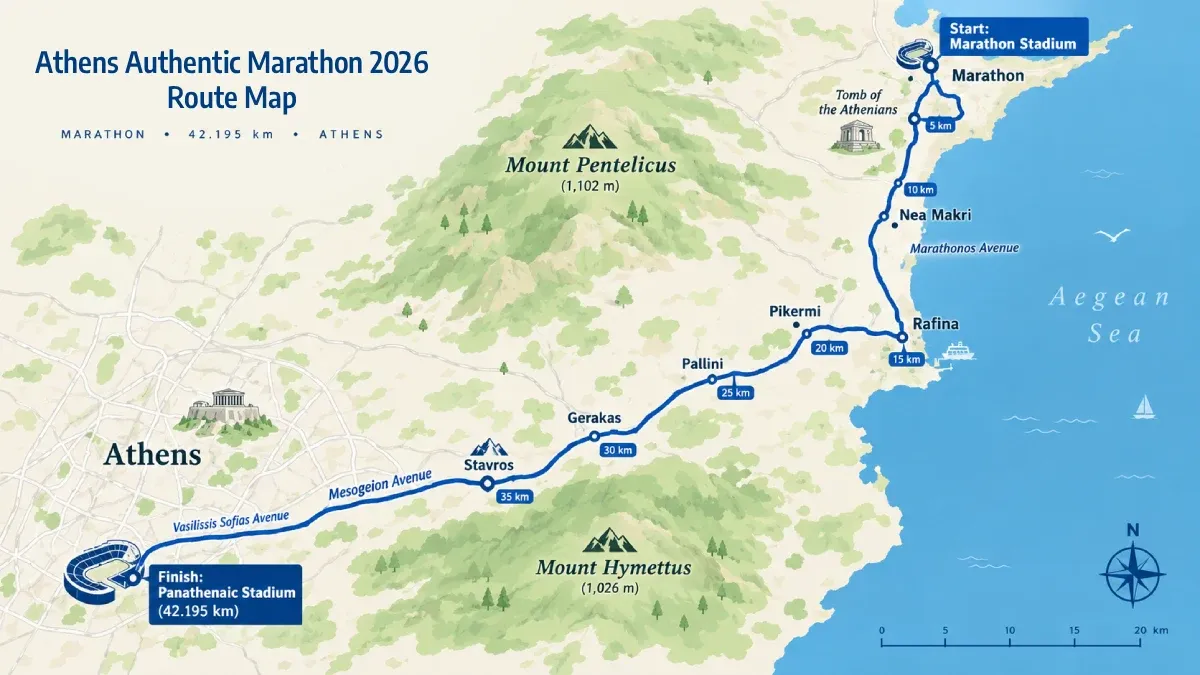
The Athens Marathon begins in the coastal town of Marathon, where runners assemble at the municipal stadium near the ancient battleground. The course directs athletes along Marathonos Avenue toward central Athens, leading the field past the commemorative Tomb of Marathon before traversing the rolling terrain of Pallini and Gerakas. As participants enter the urban perimeter, the route channels through Mesogeion Avenue and Vasilissis Sofias Avenue directly into the city center. The Athens Authentic Marathon 2026 concludes inside the historic Panathenaic Stadium, the four-century-old all-marble arena in the Pangrati district that hosted the first modern Olympic Games in 1896 and now accommodates the final official finish line.
Which roads will be closed during the Athens Authentic Marathon 2026?
Municipal authorities enforce major road closures across the Athens metropolitan area and eastern Attica to accommodate the Athens Authentic Marathon 2026. Traffic police initiate rolling closures as early as Thursday, November 5, to erect necessary infrastructure, though full vehicular shutdowns concentrate heavily throughout the weekend of November 7 and 8.
On Saturday, November 7, restrictions concentrate exclusively in downtown Athens for the preliminary 5-kilometer and 10-kilometer races. From 14:00 to 21:00, law enforcement suspends vehicular traffic along Vasilissis Amalias Avenue, Syntagma Square, Panepistimiou Street, and the immediate perimeter surrounding the Panathenaic Stadium along Ardittou and Vasileos Konstantinou avenues.
On Sunday, November 8, the shutdown expands to cover the entire 42-kilometer course. Beginning at 05:00, authorities close Marathonos Avenue in both directions from the start in Marathon to the Stavros junction. As athletes advance toward the capital, barricades extend across Mesogeion Avenue, Michalakopoulou, and Vasilissis Sofias Avenue, halting surface traffic toward the stadium finish line until approximately 18:30.
| Affected road / Area | Closure scope and description | Closure schedule |
|---|---|---|
| Herodou Attikou and Rigillis | Full perimeter closure adjacent to the National Garden | Thursday, Nov 5 to Sunday, Nov 8 |
| Vas. Konstantinou and Ardittou | Immediate arrival perimeter surrounding the Panathenaic Stadium | Friday, Nov 6 (19:00) to Sunday, Nov 8 (22:00) |
| Vas. Amalias and Syntagma | Central corridor for 5 km and 10 km preliminary events | Saturday, Nov 7 (14:00–21:00) and Sunday, Nov 8 (06:00–18:00) |
| Marathonos Avenue | Race route from Marathon municipal stadium to the Stavros junction | Sunday, Nov 8 (05:00–13:00) |
| Mesogeion Avenue | Both carriageways from Stavros to Michalakopoulou | Sunday, Nov 8 (06:30–17:30) |
| Vasilissis Sofias and Irodou Attikou | Final approach toward the stadium finish line | Sunday, Nov 8 (06:30–18:30) |
Transport restrictions in Athens during the event
The Athens Marathon substantially alters surface public transportation throughout the capital on November 7 and 8, compelling municipal transit operators to reroute dozens of bus and trolleybus lines away from the main course. Surface transit routes suspend service through pivotal transit hubs, including Syntagma, Evangelismos, and Hilton, while urban tram services terminate prematurely at the Fix station rather than accessing central avenues adjacent to the Panathenaic Stadium. Taxis, airport shuttles, and tour buses cannot cross the continuous corridor established by Marathonos, Mesogeion, and Vasilissis Sofias avenues during competition hours.
In contrast, the Athens Metro maintains full operations, operating increased train frequencies across Lines 1, 2, and 3 from early morning until midnight. Because underground subway routes bypass every street closure, rail transit offers visitors the fastest and most reliable transport link connecting the international airport, suburban hubs, and downtown cultural destinations throughout the marathon weekend.
Recommendations for visiting Athens during the event
- Rely on the Athens Metro system: Travelers should use Lines 1, 2, and 3 of the Athens Metro to navigate the city, since subway trains run uninterrupted beneath the street closures required for the Athens Marathon.
- Visit historical landmarks without scheduling disruption: Major archaeological sites operate under standard opening hours throughout the weekend because pedestrian-only zones isolate them from the marathon course. Visitors can explore the Acropolis, Parthenon, Odeon of Herodes Atticus, Ancient Agora, Roman Agora, and Hadrian's Library without race-related disruptions to site access.
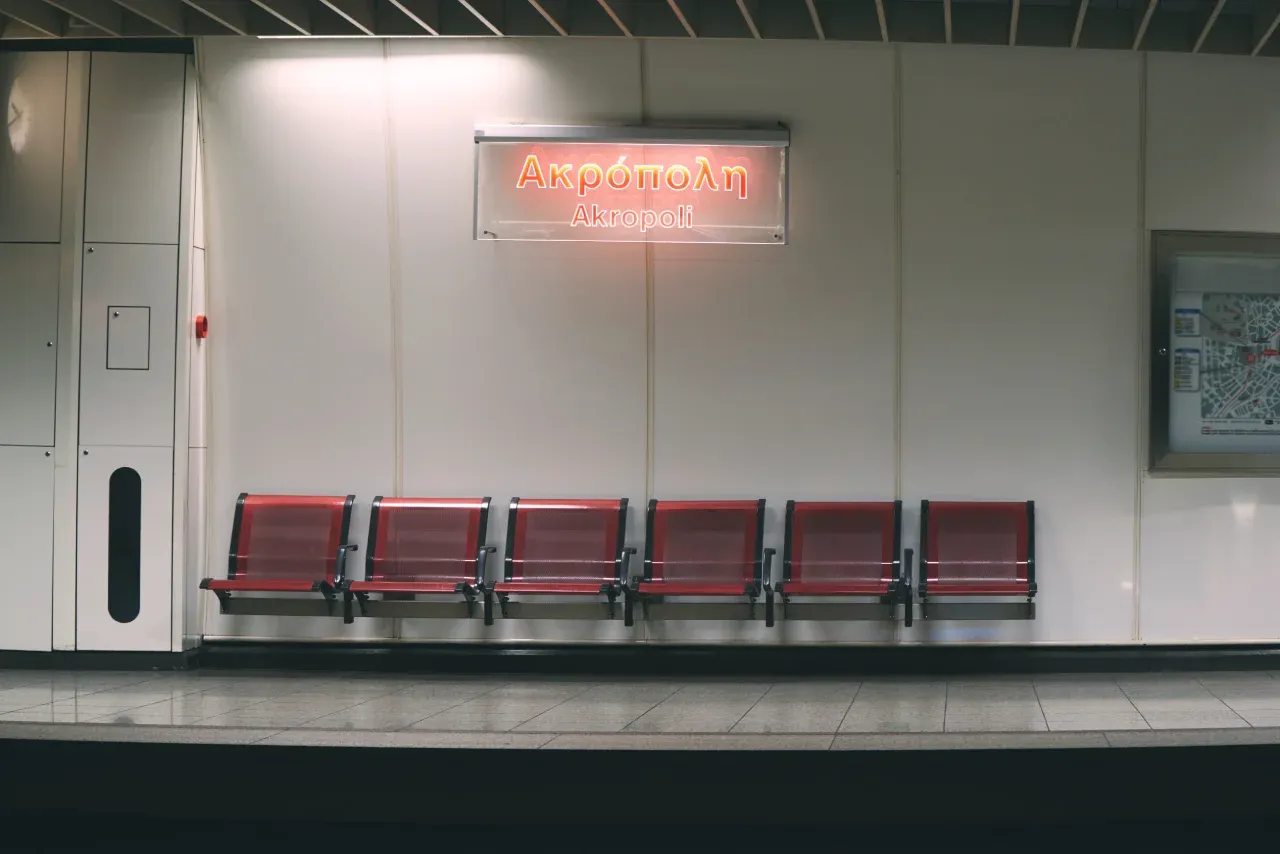
- Access surrounding cultural sites on foot: Travelers heading to the Temple of Olympian Zeus, the National Archaeological Museum, and other prominent Athens' Museums should plan walking routes or disembark at nearby metro stations, such as Akropoli, Monastiraki, or Victoria, to bypass surface road blocks.
- Prioritize rail links for airport transit: Passengers traveling between central Athens and Athens International Airport on Sunday should take Metro Line 3 or the suburban Proastiakos train, avoiding highway taxis and airport express buses that face detours.
- Cross the race corridor via designated pedestrian passages: Pedestrians needing to cross major avenues along the race circuit must use designated underground walkways or police-monitored crossing points rather than walking onto the active running route.